Want the Job? Then Don't Follow Up.
By Adam Turner, Founder, Ljos.io · 2026-07-24 · 5 min read · Marketing
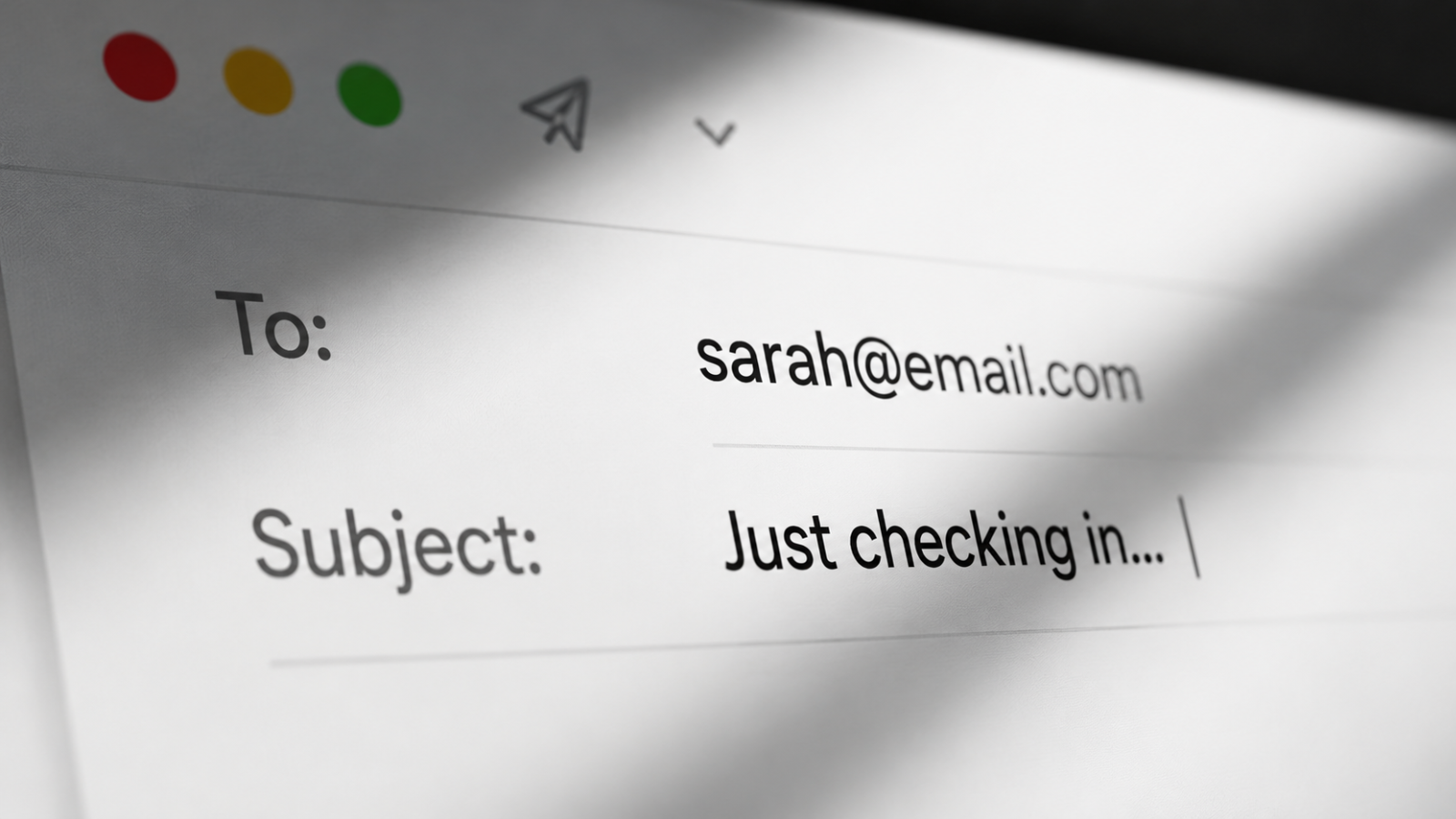
Every service business has sent a "Just checking in..." email. Almost every customer has ignored one. Coincidence? Maybe not. Discover why lazy follow-ups create pressure instead of trust, the psychology behind getting ghosted, and how to turn every follow-up into a conversation your customers actually want to open.
Want the Job? Then Don't Follow Up.
Or at least... don't send another "Just checking in..."
Let's play a quick game.
How many of these have you received this month?
Just checking in...
Thought I'd follow up...
Any updates?
Have you had a chance to review my quote?
Just bumping this to the top of your inbox.
By the third one, most of us are already reaching for the archive button.
Here's the funny part. Nearly every service business owner sends these messages because they think they're being professional. Meanwhile, the customer is reading the exact same email they've already received from their insurance broker, mortgage advisor, accountant, kitchen designer, and three people on LinkedIn trying to sell them "game-changing AI solutions."
Nobody wakes up excited to receive another follow-up email.
So maybe the problem isn't that customers are ghosting us.
Maybe it's that we've made following up incredibly easy... and incredibly forgettable.
The Psychology Behind Why It Doesn't Work
Ever heard of psychological reactance?
It's a well-established idea in psychology that says people naturally push back when they feel their freedom to choose is being pressured—even if that pressure is subtle.
Now, your email may not feel pushy to you.
But when a customer reads:
"Just checking in..."
What they often hear is:
"Have you made your decision yet?"
If they haven't?
Congratulations. You've just reminded them of another decision sitting on their mental to-do list.
Most people don't respond to that by making the decision.
They respond by... avoiding it.
The Top 5 Follow-Up Traps That Quietly Cost You Jobs
Trap #1 — Making the Email About You
The entire purpose of the email becomes:
"I need to know where you're at."
Customers don't wake up wondering how they can make your inbox happier.
They care about their project.
If every follow-up starts with what you need, you've already missed the point.
Instead...
Continue their conversation.
Trap #2 — Giving Them Homework
Every "Have you decided?" email creates work.
They now need to:
open the quote again
think about the budget
talk to their spouse
compare contractors
reply
That's a lot.
Instead, reduce the thinking.
"One thing I kept thinking about after we met... if privacy is important, extending that cedar hedge another six feet might actually look more balanced."
Now you're adding an idea—not another task.
Trap #3 — Having No Reason to Contact Them
This is the biggest mistake.
If the only reason you're emailing is because five days have passed...
Don't.
Five days isn't a reason.
A reason sounds like:
I thought of something.
I saw a project similar to yours.
Here's an idea that might save you money.
I found an example you'll probably like.
I wanted to show you something we completed this week.
Notice something?
Every one of those gives the customer a reason to open your email.
Trap #4 — Sounding Like Everyone Else
Customers don't just receive your follow-up.
They receive everyone's.
Which means your email blends into a giant beige bowl of corporate oatmeal.
Try reading these out loud.
Do they sound like something a real person would actually say?
If not...
Delete them.
Trap #5 — Forgetting That Trust Beats Persistence
People often think more follow-ups equal more sales.
Not exactly.
Better follow-ups create more sales.
There's a huge difference.
Trust isn't built because you emailed six times.
Trust is built because every interaction makes the customer think:
"This person actually understands my project."
Phrases I'd Happily Retire Forever
If you're guilty of using these...
You're not alone.
But maybe it's time to give them a well-earned retirement.
Just checking in...
Thought I'd follow up...
Any updates?
Have you had a chance to decide?
Just wanted to touch base...
Bumping this to the top of your inbox...
Wanted to see where you're at...
Just circling back...
Hope this finds you well... (Let's be honest... nobody has ever been excited to read what comes after this.)
So... What Should You Do Instead?
Imagine you just met a homeowner about a backyard makeover.
Instead of sending this...
Hi Sarah,
Just checking in to see if you've had a chance to review the quote.
Try this...
Hi Sarah,
Great meeting you today.
Driving home I kept thinking about the cedar hedge we talked about. If privacy is one of your goals, extending it while the crew is already on site may actually save money compared to doing it later.
No rush—I just thought it was worth mentioning while it was fresh in my mind.
See the difference?
One email asks for a decision.
The other contributes to one.
A few days later, maybe you finish a similar project.
Perfect.
Send a quick photo.
"This reminded me of your place."
That's not following up.
That's continuing the conversation.
Here's Where It Gets Interesting
One of the most studied principles in psychology is called reciprocity.
When someone gives us something useful—an idea, advice, a helpful observation—we naturally become more open to continuing the relationship.
You're no longer asking for attention.
You're earning it.
That's a very different feeling.
Why This Matters More Than Ever
Customers aren't ignoring businesses because they're rude.
They're busy.
They're distracted.
They're comparing options.
They're talking to family.
Life gets in the way.
Your goal isn't to remind them that you exist.
Your goal is to become the email they're actually glad they opened.
This Is Exactly Why We Built LJOS Differently
We've always believed a service business needs more than a booking page.
It needs a reason for customers to keep coming back.
A finished project.
A fresh review.
A before-and-after.
A new service.
A customer photo.
A short video.
A social post.
Every one of those becomes another natural reason to reconnect with someone who's still deciding.
Suddenly, you're not awkwardly "following up."
You're simply sharing what's happening in your business.
And that feels a whole lot more human.
Final Thought
Maybe the secret to winning more jobs isn't becoming better at following up.
Maybe it's becoming the kind of business that always has something worth following up about.
About the editor
Adam is the founder of LawnJobOS and has spent years building, operating, and growing local service businesses. Rather than writing about business from the sidelines, he shares lessons learned through real-world wins, mistakes, and countless conversations with business owners. His articles challenge outdated ideas, question industry norms, and explore how modern service businesses can attract customers, build stronger brands, and grow without adding unnecessary complexity.